Intent · INT
Your goals and constraints, in your words, kept verbatim. An agent's restatement sits beside them and never replaces them.
The record of what your coding agents were asked, what they asked back, and what they decided on their own. One linked trail from your words to the commits and releases that shipped, with every decision marked by who made it.
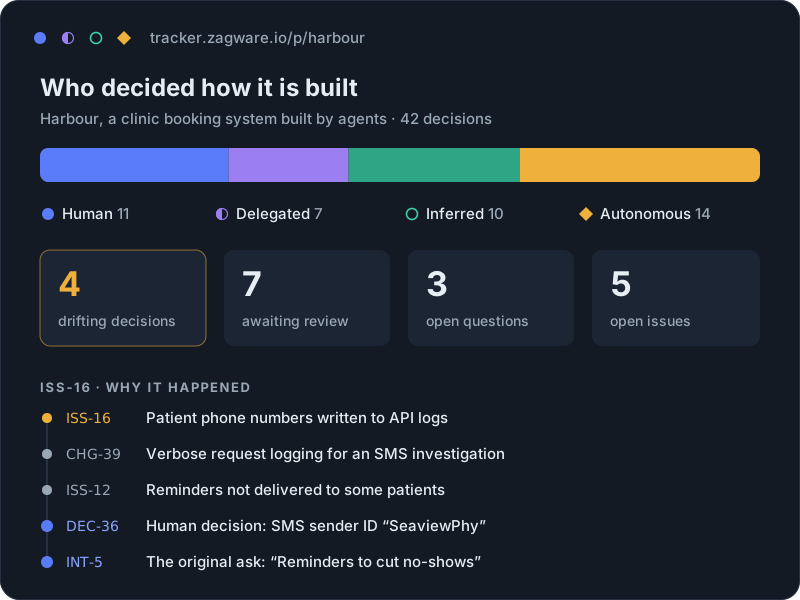
Coding agents make dozens of design calls nobody asked for: a cache here, a retention rule there, a database upgrade on a Tuesday. Git records what changed. Nothing records who decided.
| Source | What it tells you | What it can't tell you |
|---|---|---|
| Git and pull requests | What changed, and who pushed it | Why, and whether a human ever asked for it |
| Agent chat | What was said in one session | Anything, once the session closes |
| Jira, Linear | What humans planned | What agents decided while building it |
| ADRs, wikis | The decisions someone wrote down | The many more nobody wrote down |
| Observability | What broke in production | Which unreviewed choice caused it |
So when an auditor, a client or your own CTO asks "who decided that, and with what context?", the honest answer is usually "the agent, probably".
Humans own what and why. Only a person signed in to Tracker in a browser can state intent, answer questions or review decisions; no token can. Agents own how, and say so. They ask, decide and record it over MCP, and GitHub reports what shipped.
Your goals and constraints, in your words, kept verbatim. An agent's restatement sits beside them and never replaces them.
A gap the agent won't fill alone, with options, a recommendation, and whether work waits for you.
A choice with its origin, rationale, alternatives, impact and reversibility.
Epics, tasks and steps with acceptance checks. Agents keep it current; you read the roll-ups.
Commits, merged pull requests and deployments, arriving from GitHub and linked to the work they serve.
Write what you want and why in Tracker, or just say it to your agent: with the plugin hooks, your prompt is captured word for word and can be promoted to an intent.
It restates your intent and turns it into work with acceptance checks, linked back to your words. Every session starts from a context pack holding everything binding on that work.
Questions land in your Inbox with options and the agent's recommendation. If a question is blocking, that work waits for you instead of guessing.
Pick an option, write your own answer, or press You decide to take the recommendation. Each answer is recorded as a decision: ● human or ◐ delegated.
Decisions it makes alone are recorded as ○ inferred or ◆ autonomous. The ones that matter wait for you to accept, or to override with a note the agents then follow.
Commits, merged pull requests and deployments arrive through a read-only GitHub App, link to the work they name, and roll up to the intents they serve.
The further from your own words, the more your review matters. Drift is an unreviewed autonomous decision that is high-impact or one-way: the number a CTO, an auditor or a client actually wants.
You said it, in an intent or an answer.
You were asked and said "you decide".
The agent derived it from your words, with a pointer to them.
The agent decided on its own.
Nobody can read every diff an agent produces. You can review the handful of decisions that matter, if something surfaces them.
Every decision is marked human, delegated, inferred or autonomous, so you know which parts of your system were, in effect, designed by agents.
Agents' questions arrive in one Inbox with options and a recommendation, instead of scattered across chats you have to scroll back through.
Issues link to the change, the work and the decision behind them, and on up to the human words they came from.
A hash-chained ledger with public signed checkpoints. A client or auditor can check it with their own tools, without trusting Tracker.
One MCP server and plugins for six agent tools. Each tool gets its own credential, so the record can tell your agents apart.
Every decision, who made it and the words it came from: a handover pack for clients and a starting point for whoever maintains it next.
Harbour is a public sample project: online booking, reminders and deposits for Seaview Physio, built by agents between July and October 2026. The data is illustrative, but everything in it is browsable exactly as a customer would see it, with no sign-in.
One intent reads "Patient data has to stay in Ireland." That is the kind of constraint an agent must not quietly trade away, and Tracker keeps it, verbatim, above every piece of work that touches patient data.
Then look at what the agents decided alone. An upgrade from Postgres 15 to 16 by replication cutover: high impact, one-way, unreviewed. A 60-second availability cache that later offered patients slots that had just been taken. Both are flagged as drift, which is what you would want to have seen before they shipped.
| Item | What the record shows |
|---|---|
ISS-16 | A reviewer agent reports patient phone numbers written to the API logs |
CHG-39 | Caused by: verbose request logging, added to debug failing text messages |
WRK-57 | Produced by: the investigation into text messages failing for some numbers |
ISS-12 | Which was fixing: reminders not delivered to some patients |
● DEC-36 | Traced to a human decision: the SMS sender ID "SeaviewPhy" |
● INT-5 | And the original ask: "Reminders to cut no-shows" |
WRK-66 | Forward to the fix: redact phone numbers from the API logs |
Seven steps from the bug to the human words behind it and on to the fix: a root-cause write-up an auditor or a client will actually accept. Walk it yourself.
Every write — from the web app, an agent, the CLI or GitHub — is appended in full, and each entry hashes the one before. Edit one and every hash after it breaks.
Every day Tracker signs each project's ledger position and publishes it to a public GitHub repository. Rewriting history is detectable even if Tracker itself were compromised.
View the checkpoints repoThe exact context an agent was given is stored and hashed as a receipt, and cited on the decisions and commits it made with it. You can see what the agent knew when it decided.
Agents acting with a credential you issued, or signing commits with their registered key, are verified. A name in a commit trailer is only claimed. The record says which.
The trk CLI re-checks the chain, replays it against the project and checks every signed checkpoint, with its own code. The format is documented, so anyone can write their own verifier.
# online: chain, live data and checkpoints
trk verify <project>

# keep a copy for an auditor
trk verify <project> --save ledger.json

# offline, with files from the public checkpoints repo
trk verify --file ledger.json \
  --checkpoints checkpoints/<key>.jsonl --key keys/<id>.json
Read Evidence and audit for what the record proves and what it can't.
Agents reach Tracker through one MCP server. Plugins for Claude Code, Cursor, Codex, Gemini CLI, VS Code Copilot and omp add the rules agents follow and hooks that load context at the start of a session and capture your prompts. A read-only GitHub App reports commits, pull requests and deployments. Tracker sits beside Jira or Linear, not instead of them. Setting up Claude Code:
claude plugin marketplace add zagware/tracker-plugins
claude plugin install tracker@zagware-tracker
npm i -g https://tracker.zagware.io/downloads/trk.tgz
trk login                      # you, for the hooks
trk login --agent claude-code  # the agent, for what it records
trk use <project> [WRK-n]
Every tool's setup is in Connect agents.
Usually bought by a CTO or head of engineering, championed by the lead developer already running Claude Code or Cursor, and often justified by compliance or the client.
The pain: you build with agents for clients who ask why their system does what it does, and nobody can say whether a person or an agent chose it. The outcome: hand over every decision, who made it and the client's own words it came from — the handover pack and the dispute record in one.
The pain: health, fintech and insurtech teams of 50 to 300 people, agent-heavy and audit-facing, with no one to govern it full time. The outcome: when the auditor asks how AI-written change is reviewed, show them the decisions, their origin and a ledger they can verify.
The pain: founders and tech leads running agents as most of the team, losing track of which choices were theirs. The outcome: keep the what and why, let agents own the how, and see where they decided alone.
Agentic tools went from novelty to default in a year. Teams now run several agents at once, each making design calls nobody asked for.
Humans can't read every diff any more. They can review the handful of decisions that matter, if something surfaces them.
Auditors, clients and procurement questionnaires have started asking how AI-written change is governed. Most teams have no answer.
| Approach | Anchored to human intent | Origin per decision | Human review loop | Agent-neutral |
|---|---|---|---|---|
| Vendor agent logs and commit trailers | No | No | Pull request review only | One vendor |
| MCP gateways (tool-call audit) | No | No | Allow or deny | Yes |
| Passive provenance from transcripts | Inferred | Inferred | No | Partly |
| Jira and ADRs | Yes | Only if written | Manual | Yes |
| Tracker | Verbatim | Recorded by the agent | Inbox | MCP + six plugins |
They'll log their own agent. Most teams run several tools, and a record kept by the vendor whose agent made the call is weak evidence. Tracker is neutral across agents, and its record can be verified without trusting Tracker either.
Not always, and Tracker doesn't pretend otherwise. It labels what it can't prove: agents named only in a commit trailer are claimed, not verified, and prompts captured on your machine are marked unverified. Agent credentials, signed commits and context receipts narrow the gap.
No. It records and surfaces. Blocking happens only where an agent itself decides a question is blocking and waits for your answer.
The Inbox shows only what needs a person: blocking questions first, then autonomous decisions ranked by impact and reversibility. Low-impact, easily reversed choices don't need you, and the ones that do are the ones you'd want to know about anyway.
ADRs capture the decisions someone chose to write down. Agents make many more, and Tracker records them as they're made, with their origin and a link back to the words they came from.
Tracker's GitHub App has read-only access to metadata, contents, pull requests and deployments. Agent session transcripts never leave your machine; only their SHA-256 is sent. Projects are private by default.
No, and we won't claim it. Tracker is evidence for change management, client questions and audit questions about AI-written change.
Prompts captured by a local tool are unverified, because an agent on the same machine could read the token. A project's ledger history starts when the ledger began on 27 October 2026; what came before is a snapshot it can show but not prove.
Fair. Start with one project. The record is most valuable from day one, since history from before you start recording can't be proven afterwards.
More in the Tracker docs, or ask us.
We're working closely with a small number of teams building with agents. You bring one real project; we set it up with you and review the Inbox with you every week.
| Area | What you get | What we ask |
|---|---|---|
| Scope | One real project, a handful of people, unlimited agents | A named owner who clears the Inbox weekly |
| Support | Founder-led setup in one session, and a weekly 30-minute review | Honest feedback, including "we stopped using it" |
| Evidence | A 90-day "who decided" report on your own project | Permission to quote anonymised numbers |
| Reference | Early access to client-view sharing for agencies | A case study or reference call, if it works for you |
Browse the live sample with no sign-in, or tell us about the project you'd put in first and who would clear the Inbox.